


13.04.2026
FIFAe World Ranking Explainer
The FIFAe World Ranking reflects the competitive strength of national teams based on match results across FIFAe competitions. The rating evolves continuously as new match results are recorded, providing a structured and objective measure of national team performance. The system uses an Elo-based methodology.
What is Elo?
The Elo-based methodology is a statistical rating system used to calculate the relative skill level of competitors based on match outcomes. Originally developed for chess, it is now widely adopted across sports and esports due to its fairness, accuracy, and dynamic nature.
How It Works
Baseline Rating: Every competitor (player, club, or national team) begins with a predefined baseline rating, e.g. 1000.
Expected Result: Before each match, the system calculates the probability of each competitor winning based on the difference between their current ratings. A higher-rated competitor has a greater expected probability of victory.
Actual Result: After the match, the actual outcome (win, draw, or loss) is compared to the expected result.
Rating Adjustment: Ratings are adjusted proportionally to the margin of surprise:
A win against a higher-rated opponent results in a significant rating gain.
A loss against a lower-rated opponent results in a significant rating loss.
A win against a lower-rated opponent results in a modest rating gain.
A loss against a higher-rated opponent results in a modest rating loss.
Continuous Update: Ratings are recalculated after every eligible match, ensuring the system always reflects current competitive form.
The FIFAe World Ranking is based exclusively on eligible match results aggregated and recorded within the FIFAe competitive ecosystem. As more results are recorded, rankings become increasingly accurate and representative of competitive strength.
The methodology may be refined over time to further improve accuracy, fairness, and transparency.
How Ratings Evolve
Every eligible match contributes to the rating. For example, when a nation defeats a higher-rated opponent, the rating increase is greater. When a nation loses to a lower-rated opponent, the rating decrease is greater. This ensures that rankings reflect the relative strength of national teams based on competitive performance. Consistent success against strong nations leads to progressive ranking improvement, while inconsistent results may result in rating decreases. The system ensures that rankings reflect sustained national team performance rather than isolated results.
How The FIFAe Performance Index is Calculated
The FIFAe World Ranking uses a structured Elo-based rating model to calculate how a nation’s performance index changes after each eligible match. This model compares the actual match result with the expected outcome, while also incorporating factors such as match importance and result margin.
The performance index is updated using the following formula:

R_old = Nation’s performance index before the match
R_new = Nation’s performance index after the match
K = Base adjustment constant (K-factor), which determines the overall sensitivity of rating changes (set to 40 to balance responsiveness and stability)
G = Goal difference factor (G-factor), reflecting the margin of victory
F = Stage factor (F-factor), reflecting the importance of the competition stage
S = Actual match result
1.0 = Win
0.5 = Draw
0.0 = Loss
E = Expected result, representing the probability of winning based on rating difference
The structure ensures that performance score adjustments reflect not only the outcome of a match, but also the strength of the opponent, the margin of victory, and the competitive importance of the match.
Expected Result Calculation
The expected result (E) represents the probability of a player winning against a specific opponent, based on the difference between their performance scores.
It is calculated using the following formula:
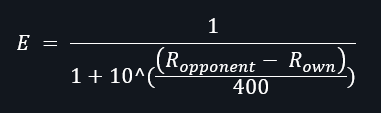
This produces a value between 0 and 1.
For example:
If both players have equal performance scores, each has an expected result of 0.50
If a player has a higher score than their opponent, their expected result will be greater than 0.50
If a player has a lower score, their result will be less than 0.50
Unexpected results therefore produce larger performance score adjustments, while expected results produce smaller adjustments.
Goal Difference Factor (G-Factor)
The G-factor adjusts the performance score change based on the margin of victory, ensuring that stronger match performances are appropriately recognized, while maintaining controlled rating stability.
The G-factor follows the structure used in the World Football Elo Rating model:
Goal Difference - G-factor
1 goal - 1.00
2 goals - 1.50
3 goals - 1.75
4 goals - 1.88
5 goals - 2.00
Maximum - 2.625
For goal differences of three or more, the G-factor is calculated using:
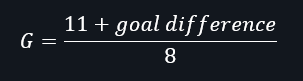
This ensures that larger victories increase rating adjustments proportionally, while maintaining controlled limits to prevent disproportionate rating swings.
Stage Factor (F-factor)
The F-factor adjusts rating changes based on the competition stage, ensuring that higher-importance matches have greater influence on performance scores. This allows the system to reflect the increasing competitive significance of matches across the competitive pathway.
For example, matches played in the FIFAe World Cup knockout stage have a higher stage factor than group stage matches of the FIFAe Nations League, reflecting their higher competitive importance.
Stage factors are defined as follows:
Competition stage - Stage Factor
FIFAe Nations League Group Stage - 0.90
FIFAe Nations League Knockout Stage - 1.10
FIFAe Continental Championships Group Stage - 1.10
FIFAe Continental Championships Knockout Stage - 1.30
FIFAe World Cup Group Stage - 1.30
FIFAe World Cup Knockout Stage - 1.75
This ensures that FIFAe World Cup matches, particularly knockout matches have the strongest influence on the rankings and reflects the increased competitive importance and global significance of these matches.
Expected Outcome and Rating Adjustment
Before each match, the system calculates the expected probability of each player winning based on their current ratings. If the expected outcome occurs, rating adjustments are smaller. If an unexpected outcome occurs, rating adjustments are larger.
Consider the following example:
Nation performance index = 1600
Opponent performance index = 1800
Match result: Win
Goal difference: 2 goals
Competition stage: FIFAe World Cup Knockout Stage
Step 1: Calculate the expected result
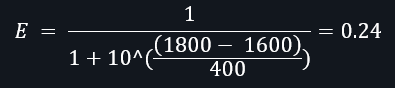
Step 2: Apply formula
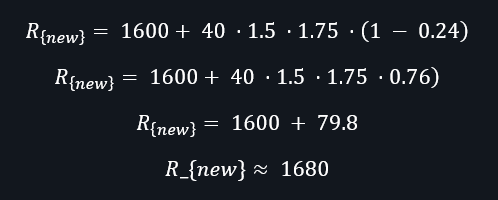
This reflects a significant increase due to:
Defeating a higher-rated opponent
Winning by multiple goals
Competing at a high-importance stage
Emerging nations will climb the rankings through strong and consistent competitive performance. As more international matches are recorded, the rankings become increasingly accurate and representative of sustained competitive performance.